
April 6, 2026

With tools like Lovable, Bolt, and Claude Code putting functional app generation in the hands of non-engineers, the low-code/no-code question isn’t whether to use these tools—it’s which decisions they should and shouldn’t own. LCNC adoption is no longer a leading-edge bet. It’s now a typical starting point. As with most defaults, it creates problems when applied without judgment.
The organizations that use these platforms well have one thing in common: they matched the tool to the stakes. The ones that struggle tried to scale a workaround into a core system.
When to Use LCNC—and When Not To
Start here. Before any strategic assessment, run the use case through this lens:
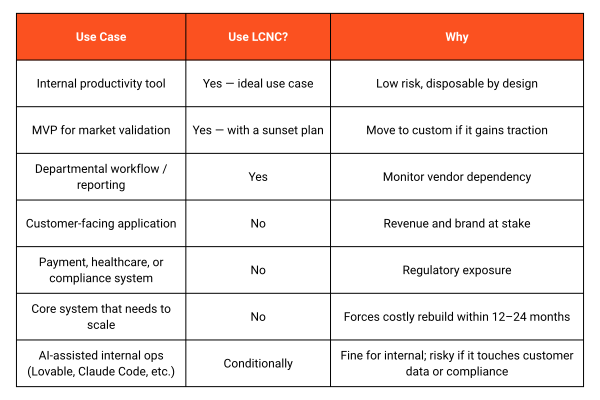
The pattern is consistent: LCNC earns its place when the work is internal, low-stakes, and disposable by design. It becomes a liability the moment it touches revenue, compliance, or your scaling architecture.
Strategic Assessment Framework
The decision table covers the common cases. The harder calls come when project complexity grows, scalability becomes a real constraint, or long-term strategic goals shift the picture. What follows is the reasoning behind those calls.
When LCNC Delivers Value
LCNC platforms excel in scenarios where rapid deployment outweighs long-term flexibility concerns and where project complexity remains within platform capabilities. Optimal applications include:
- Internal productivity tools and workflow automation
- Minimum viable products for market validation
- Data visualization and departmental reporting systems
Successful implementations leverage platforms like Microsoft Power Apps for expense reporting, OutSystems for customer service portals, Zapier for lead automation, and Airtable for project tracking. More recently, tools like Lovable and Bolt have expanded this category to include AI-assisted prototyping and internal tooling—useful for teams that need to move fast on low-stakes work.
These tools shine when requirements remain stable and user bases stay manageable. However, extending LCNC beyond its intended scope creates operational challenges. Building high-traffic e-commerce platforms on Airtable or real-time financial trading systems through Zapier introduces performance bottlenecks and reliability concerns that can compromise business operations.
When Custom Development Becomes Necessary
While LCNC excels at standard workflows, certain business requirements push beyond platform capabilities. Custom development becomes strategically necessary when LCNC limitations could impact revenue, compliance, or competitive positioning:
- Revenue and brand exposure: Customer-facing applications requiring enterprise-grade reliability, performance optimization, and professional user experiences. Downtime or degraded performance in these systems has a direct revenue and reputational cost.
- Zero tolerance for failure: Mission-critical systems—payment processing, healthcare management, financial trading, and supply chain operations—where downtime creates significant financial, safety, or compliance risks.
- Where your IP lives: Complex business logic—dynamic pricing algorithms, insurance underwriting, real-time supply chain optimization. This is proprietary logic that drives competitive advantage—outside LCNC’s component-based limitations.
- Where LCNC’s API reach ends: Legacy system integration—mainframe connections, proprietary protocols, SOAP services, and legacy XML systems that extend beyond what mainstream LCNC platforms support.
- The compliance floor: Regulated environments—finance, healthcare, and manufacturing—require SOX compliance, HIPAA-compliant data handling, FDA validation protocols, and custom audit trails that generic platforms cannot accommodate.
For PE-Backed Companies: Timing Matters
In the first 100 days post-acquisition, LCNC tools can accelerate quick wins and diagnostic workflows—useful for demonstrating early momentum without large capital commitment.
By year two of a hold period, any LCNC dependency touching core systems becomes a technical debt conversation at the board level — and the clock started the moment the first workaround shipped.
Pre-exit, undisclosed LCNC dependencies in critical systems surface in diligence—and become a valuation discussion. Build custom where it matters, early.
Platform Dependency Risks
LCNC adoption creates dependencies on external vendors whose business decisions can impact your operations. Platform changes, pricing adjustments, or service discontinuation can force expensive rebuilds and operational disruptions.
Two examples illustrate the range:
Risk realized: A client’s chosen LCNC platform discontinued service unexpectedly, causing immediate system failures and requiring complete component rebuilds that doubled project costs and created significant service interruptions.
Risk managed: A separate engagement used LCNC deliberately for internal ops—workflow routing and reporting dashboards that the team built in weeks. When requirements evolved 18 months later, the scope was small enough to migrate cleanly. The savings on that initial build funded a third of the custom system that replaced it.
The difference wasn’t the platform. It was the decision about which work belonged there.
Custom development preserves what matters most: codebase ownership, infrastructure control, and independence from external vendor decisions. That’s the foundation of strategic autonomy over critical systems.
Security and Compliance Considerations
LCNC platforms introduce specific security challenges that organizations must evaluate against their requirements.
Third-party platform limitations include restricted visibility into security practices, limited access control granularity, and constraints on enterprise identity management integration.
Regulatory compliance gaps become apparent in industries requiring specific frameworks. Financial services need custom audit trails and real-time fraud detection, healthcare requires patient consent management and EHR integration, manufacturing demands FDA validation and supply chain traceability.
Data sovereignty concerns arise from shared environments with limited control over encryption, backup procedures, and data residency requirements that may conflict with compliance mandates.
Platform vulnerabilities create single points of failure where security issues can expose multiple applications simultaneously, affecting entire business processes.
Cost Considerations Beyond Initial Investment
LCNC platforms carry hidden costs beyond initial implementation. Organizations face learning curves for new interfaces, production risks from prioritizing speed over precision, and engineering gaps—including limited version control and testing frameworks that require costly workarounds.
Potential platform instability compounds these issues through frequent updates and breaking changes that force system rewrites. Additionally, per-user licensing fees create ongoing expense commitments that scale with growth, unlike custom development’s more predictable cost structure.
Performance and Scalability Boundaries
LCNC platforms work well for standard workflows but struggle with performance-critical applications requiring optimization for speed, memory efficiency, and large-scale user bases. Custom development unlocks what LCNC can’t reach: pixel-perfect user experiences, AI/ML systems, and proprietary algorithms that drive real competitive advantage. It also supports the enterprise infrastructure layer—CI/CD pipelines, observability tooling, scalable cloud architecture—that high-growth teams eventually require.
Organizations frequently migrate LCNC applications to custom solutions when growth demands exceed platform limitations. That migration typically costs 2–3x the original build. The decision to use LCNC for a core system is often made under time pressure; the decision to rebuild it is made under financial pressure.
Hybrid Implementation Strategies
Many organizations balance LCNC and custom development by mapping tools to appropriate use cases. LCNC platforms like Retool or OutSystems handle internal tools, admin dashboards, and workflow automation, while custom development using React or Python addresses customer-facing applications and complex backend logic requiring scalability and customization.
The same principle applies to the newer generation of AI-native tools. Claude Code and similar agentic development environments can dramatically accelerate internal tooling and prototyping—but the output still needs to be evaluated against the same criteria: Is this internal or external? Is it disposable or foundational? Does it touch compliance or revenue?
The tool’s sophistication doesn’t change the stakes of the decision.
Strategic Decision Framework
Technology choices compound. Before committing to an LCNC platform, assess the full picture: project complexity, total ownership costs including hidden expenses, and whether the solution fits your actual needs—not the vendor’s positioning.
A successful technology strategy balances rapid deployment capabilities with long-term scalability, security, and strategic autonomy requirements. The goal isn’t to avoid LCNC—it’s to use it only where the tradeoffs are acceptable.
Working through a decision like this? REEA Global helps PE-backed teams navigate these calls.